
Key Teachings
In today’s world, where our attention is constantly pulled by the allure of social media algorithms, the need to return to a more genuine sense of myself has never been greater. Gurdjieff’s exhortation to “remember myself,” when practiced sincerely, can anchor my attention inward and serve as an antidote to the superficiality that surrounds me.
It is not possible to fully capture the breadth of Gurdjieff’s teachings—from the vastness of the Macrocosm to the intimacy of the microcosm—in just a few sentences. Nevertheless, the following points offer a ‘taste’ of our approach to living and studying this path.
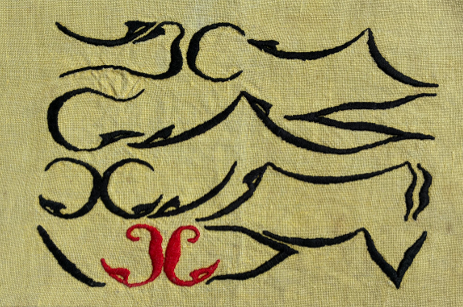
An aphorism from Gurdjieff, written in a language developed with some close pupils

1. The purpose of humanity
Gurdjieff invites us to ask, Who and what am I? – suggesting that freedom from the constraints we place upon ourselves, formed by our nature, upbringing, and environment, is possible through a dynamic, guided process of personal inquiry and inner exploration; to open the possibility of serving something other than myself.
2. Man is asleep
Most of us live in a sort of ‘waking sleep’, where we go about our lives, get a job, have a family, and all the rest, without being fully conscious – and all the time subject to every kind of inner and outer influence.
Gurdjieff’s teaching shows, through the carrying out of guided personal exercises, that by certain efforts we can learn to wake up, to become more aware, more present, and take our true place in this world as conscious human beings.
3. The Power of Attention
Gurdjieff emphasises the transformative power of our attention. This is the tool that we all have available to us, but which we allow to be pulled every which way, to whatever attracts our interest in the moment.
He calls this tendency “identification”—where we become absorbed in something and lose ourselves.
By training our attention, (much like an athlete building muscle) we can learn to observe and participate fully in life while remaining anchored in ourselves.

Attention unites the higher and lower. But it is not free. It needs a ground: the body.
Mme de Salzmann

4. Man is a multitude
Within us all there are many small individual parts that call themselves “I”.
Each one seeks to rule over the rest. Gurdjieff gives exercises to help us firstly see these various “I”s and to gradually bring them together, to be harmonious under a central “I”, the Master or true Self.
His last book even has the title Life is Real Only Then, When I Am. He placed great emphasis on ‘I AM’ – not in any egotistical way, but to begin waking up to a more conscious awareness of who I am; to begin to become the truly authentic ‘me’.
5. Work in Daily life
Gurdjieff was insistent that his Fourth Way teachings were best practiced in life.
It is only in our daily living – with all its joys and sorrows, wins and losses, pleasures and pains - with all that friction, that the real and permanent growth of the ‘Self’ can arise.
I AM


6. As above, so below
Gurdjieff recognised a rational, cosmological order exists, from the highest to the lowest, from the Absolute above to the Absolute below.
He teaches that we all embody this same order within us, and that we have a significant role to play within that greater order.